Ricketts Bioprogressive Society
It was Guy Perrier d'Arc who came up with the idea of bringing together colleagues who had taken courses on the "Ricketts bioprogressive method". Following a meeting organized on November 19, 1972 during the "small session" of the SFODF, at the Faculty of Montrouge, a Provisional Bureau was formed.
The founders were not mistaken, as we can see today that very good results have been achieved.
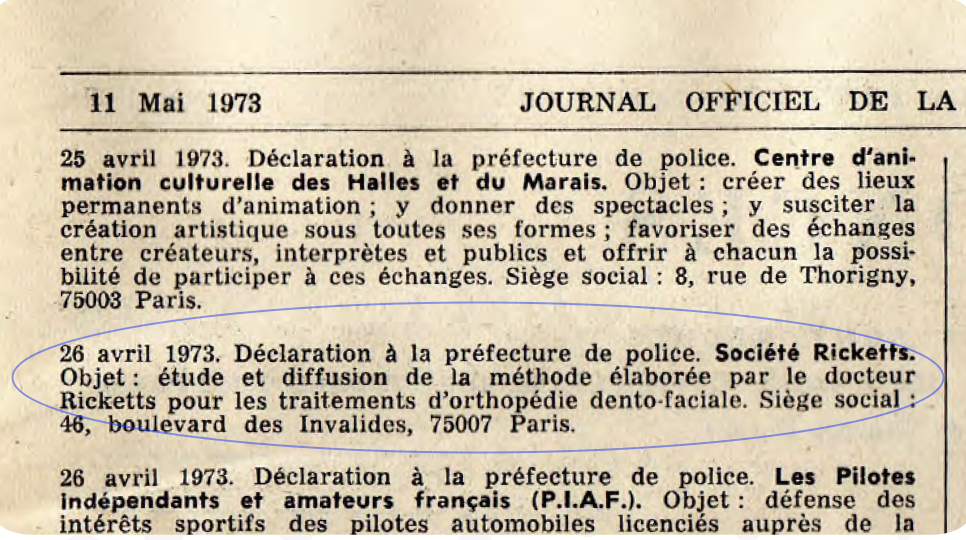
The statutes, drafted with the assistance of Jacques Barbary, were published in the official journal on May 11, 1973, and the "Ricketts Company" was born.
Official bulletin of May 11, 1973: creation of the Bioprogressive Ricketts Society
That same month of May, the first BULLETIN, initially a simple liaison between the different regions, was published thanks to the kindness of Martin P. Hamilton, director of Rocky Mountain Products Co. France.
This "bulletin," consisting of just a few pages, grew in importance over the years, eventually becoming "Bioprogressive Orthodontics."
It is a veritable "Orthodontic Philosophy," according to the title of the provided manual, that is taught to the first participants. The aim is to offer a method for managing diagnostic and therapeutic reasoning: a mechanical approach integrating function and growth, visualizing treatment objectives, without neglecting the organization of chairside practice.
A "comprehensive method" for learning orthodontics that must answer the 3 famous questions:
What?
Why?
How?
Orthodontic France in the 1960s saw the consecration of Tweed's concepts, imported by RX O'Meyer, which opened the era of modern orthodontics, despite questionable diagnostic values and mechanical means.
Edgewise technology supplanted detachable devices, but dissenting opinions were already emerging with the appearance of the concept of "light forces" and the birth of Begg's technique. Ricketts's innovative thinking was a bombshell in this mechanistic landscape. It remains revolutionary even today.
Let us recall what President J. Philippe reported in the first editorial of our "Bulletin". He wrote:
Presentation of the Society
The Ricketts Society is founded.
It was born from the meeting of about fifty orthodontists who, having understood what the best current orthodontic method is, wanted to explore it further, follow its evolution, and disseminate it.
If each of these practitioners experiences the pride and pleasure of working according to the latest technique, and if their patients can benefit from its advantages, it is thanks to the dynamism and enthusiasm of one man, Carl F. Gugino.
In 1966, a young American practitioner, whose practice was nevertheless expanding rapidly, agreed to spend several weeks in France.
He was unknown there, had no academic qualifications, his words were met with suspicion, and he was barely reimbursed for his expenses. But he convinced them. And he returned, driven by an irrepressible desire to share his faith in the method of his mentor, Dr. Ricketts, and by his passion for orthodontics. Behind the practitioner's forceful touch lay the fervor of an evangelist. We owe him an immense debt of gratitude.
At the next ADF International Congress, Carl Gugino will be honored: it is the least that French practitioners owed him.
One could apply to the orthodontist this phrase from Goethe: "knowing and doing one thing well proves a higher development than doing a hundred things half-heartedly".
It is to help us to know well and to do well that the Ricketts Society was born, which brings together those whom C. Gugino trained, directly or indirectly.
The lectures are always too short, and many of us feel the need to solidify our knowledge, the desire to compare diagnoses or treatment plans within a small group where everyone actively participates in the discussion. This is the type of exchange of views that the SFODF no longer allows due to its large membership, and that is why we have adopted the regional group model.
Regarding matters of common interest (relations with the Foundation for Orthodontic Research, etc.), a choice had to be made between frequent national meetings and home-based information. We opted for the newsletter, a friendly, convenient, and, we hope, effective means of communication.
The Society has been launched. Let's wish it good luck, but let's remember that it will only move forward with the breath of each and every one of us.
J. Philippe.
Since then, the passion has not waned.
Initially, courses were organized four times a year, always led by Carl Gugino accompanied by Michel Delamaire, an interpreter of both the language and the thought of this practitioner.
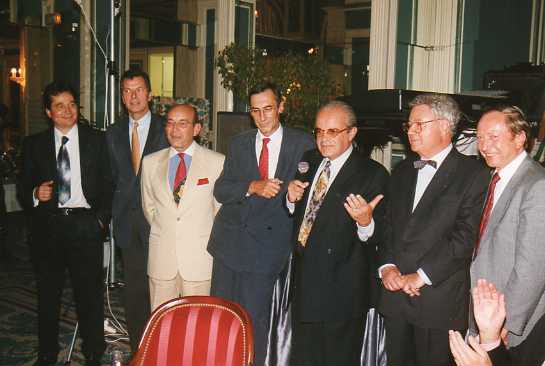
La Baule 1998: from left to right: Daniel Rollet, Claude Chabre, Alain Béry, Michel Delamaire, Carl F. Gugino, Julien Philippe, Guy Perrier d'Arc.
The leaders of the "Regions" bring together their members three times a year, for one or more days, for continuing education cycles where all subjects concerning the reports of the ODF and other disciplines of the Art of Dentistry are addressed by specialists and academics.
The "National Days" of our Society are held for two or more days every two years in each of its constituent Regions, or sometimes in the Overseas Territories, such as Guadeloupe and Martinique, or abroad, for example, in Mauritius in 1988.
Since then, other countries have hosted our Society. It is by looking back that we can measure the progress made. The different regions, after structuring themselves in their own way, have pursued the same goals: to raise awareness of the bioprogressive method and to promote it.
We can affirm that they have succeeded. For, contrary to the naysayers who would have it portrayed as an easy and incomplete technique, for those who practice it as it was taught to them, it has the same basic requirements as others and in fact demands much more.
Because Drs. Ricketts and Gugino have always insisted, for the sustainability of the results, on the quality of the end of treatment, naturally emphasizing the best interlocking of the cusps of the teeth in the lateral sectors, but also on the re-education of the different functions, to respond to the logic and coherence of the "bioprogressive concept".
Let us not forget that this method is one of the few fixed techniques that can be applied in mixed dentition, which does not seem negligible to us.
And most importantly, no doubt, is the ability of the bioprogressive concept to integrate emerging therapeutic advances and thus to keep pace with the evolution of orthodontics because it is devoid of the rigidities that create ankylosis.
Finally, if we were fifty practitioners at its inception, we find ourselves nearly seven hundred today.
What better praise for Presidents J. Philippe, G. Perrier d'Arc, M. Bonnerot, M. Delamaire, A. Béry, Cl. Chabre, D. Rollet, F. Bazin and E. Lejoyeux who inspired the ideas, the members of the Board of Directors who made them a reality, not forgetting "the active members", and our departed friends, all have contributed over the years to making the Bioprogressive Ricketts Society the second largest orthodontic society in France.
L. Chavand and B. Terk,
former editors of the "Bulletin"